Enhancing Coastal Ecosystem Services: ENHANCES Explores Solutions through Games
Children play games to learn about the world. Games help us explore our environment, develop our social skills, and understand how to address complicated challenges. They offer a powerful tool that engages individuals to think differently about complex problems and provide psychological safety for experimentation. Gamification, the use of games and game elements in a context beyond entertainment, has the potential to facilitate cooperation and knowledge sharing around convoluted and sometimes contentious issues.
One particularly complex challenge facing tropical coastal regions is coastal erosion and flooding. In Suriname, the effects of this problem are particularly potent. With climate change threatening both rising seas and unpredictable storms, protection of Suriname’s coastline and the 85% of Suriname’s population that lives in this region is critical. The country’s mangrove green belt has historically provided protection to this coastal region, but environmental factors and human land use have weakened these ecosystems and the protection they provide.
While a major focus of the GCBC funded ENHANCES project is collecting environmental data from coastal Suriname to better understand mangrove ecosystems as a nature-based solution for flood protection, gaining insight into what is happening and why is only part of the challenge. Developing effective approaches to reduce erosion and flooding requires consensus and collaboration from stakeholders in the country. However, limited resources and differing views on the best strategies make this process particularly challenging.
To support dialogue and knowledge sharing around this issue, ENHANCES is developing an interactive boardgame. The game aims to foster constructive conversations among stakeholders.
Resilient Coast: The Game
The development of this game began with a clear goal: building consensus. The design team set out to create a space where dialogue among stakeholders with diverse, and often competing interests, could take place. The design team is led by Dr. Agnessa Spanellis, Senior Lecturer in Systems Thinking and Dr. Sandy Louchart, Research Associate in Game Design, at the University of Edinburgh, working closely with the Anton de Kom University of Suriname, particularly Dr. Fariel Ishaak and Graciella Hunte from the Faculty of Social Science and Prof. Sieuwnath Naipal (Faculty of Technological Sciences), and supported by the whole multi-disciplinary ENHANCES team, led by Dr. Isabella Bovolo from the Department of Geography at Durham University.
The game is seen as a first step toward consensus building on coastal flood mitigation, offering participants an opportunity to reflect on the issue. To do so, it must establish a baseline of knowledge about tropical coastal protection. This baseline combines factual insights from scientific literature and experts (within the ENHANCES team and elsewhere) with the perspectives and opinions of stakeholders in Suriname and the region. From this foundation, three broad questions emerge about the role of mangrove ecosystems in mitigating coastal flooding:
- What information is relevant to players?
- What is currently known and supported by scientific evidence?
- What do experts believe should be done?
In May 2023, interviews were arranged with local stakeholders and insights from these conversations helped identify the core requirements for the game.

It was very enriching to understand experiences of different people on the ground and see what they are doing to cope with the floods. Some of them said that nobody has asked them about their experiences before.
Dr. Agnessa Spanellis, Senior Lecturer in Systems Thinking, University of Edinburgh
These insights, together with scientific evidence on coastal processes, were brought together in a causal map—a tool that visualizes the actions and consequences within a complex system to help identify key information, elements, and processes. The map was cross-referenced with project experts to clarify existing knowledge and identify gaps related to coastal flooding in Suriname
From this data, the first prototype of the game was born. Priority learning outcomes were established first, and game mechanics followed based on these initial aims. Some knowledge could be shared with the players simply and directly. The more complex concepts, however, are better communicated through experience and observation (constructivist learning). These experiential loops would develop into game mechanics, driving the game and engaging the players in problem solving.
What does the game look like now?
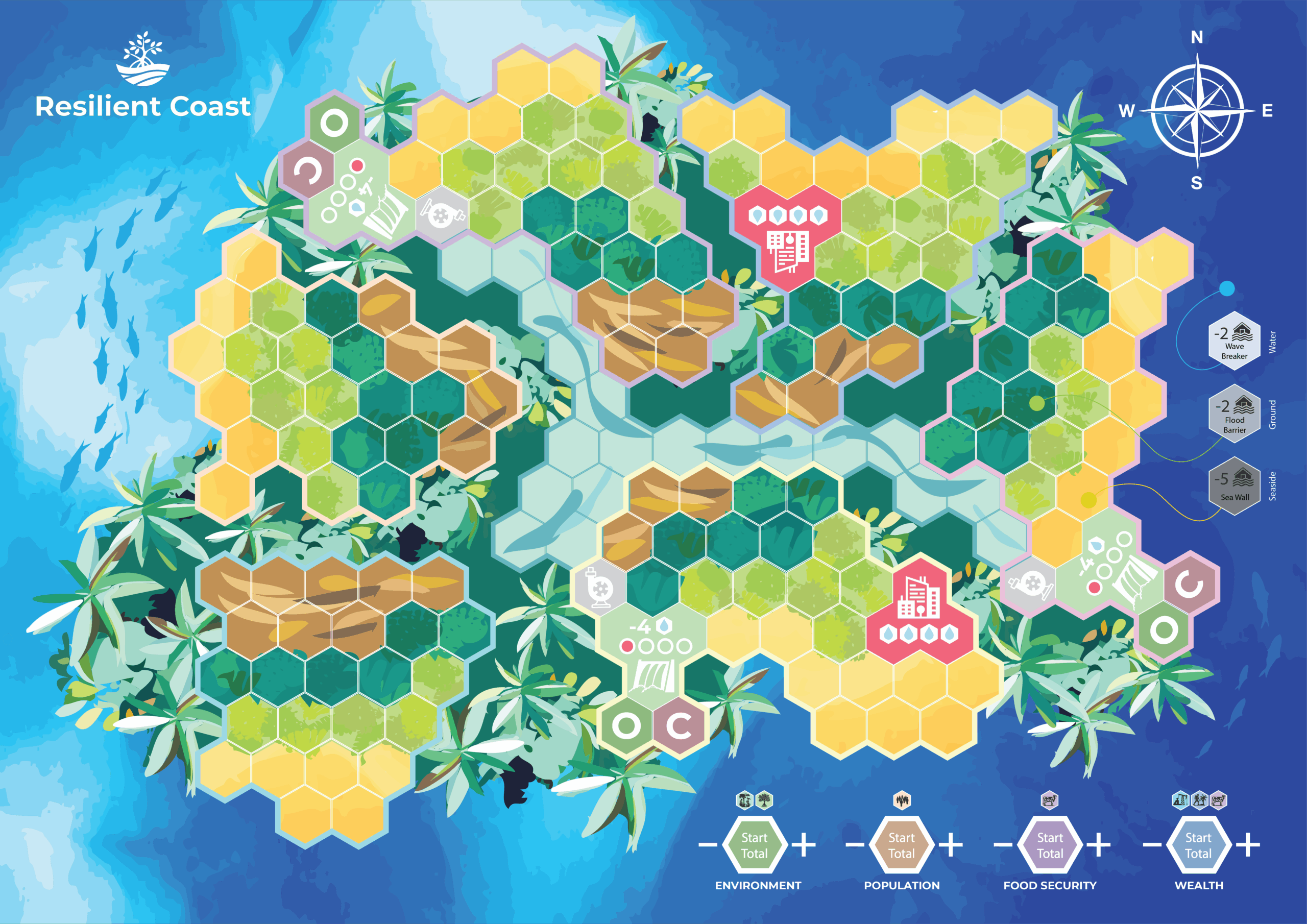
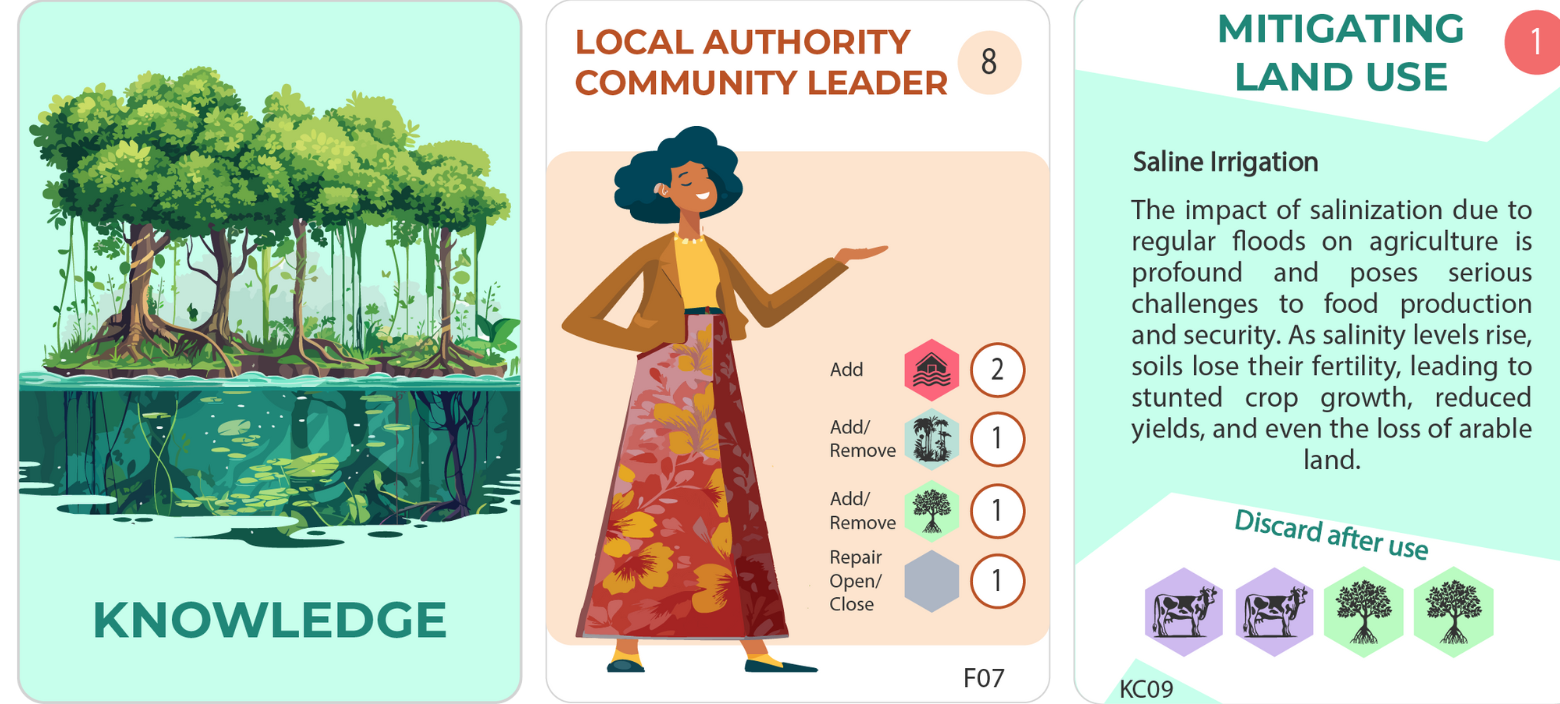
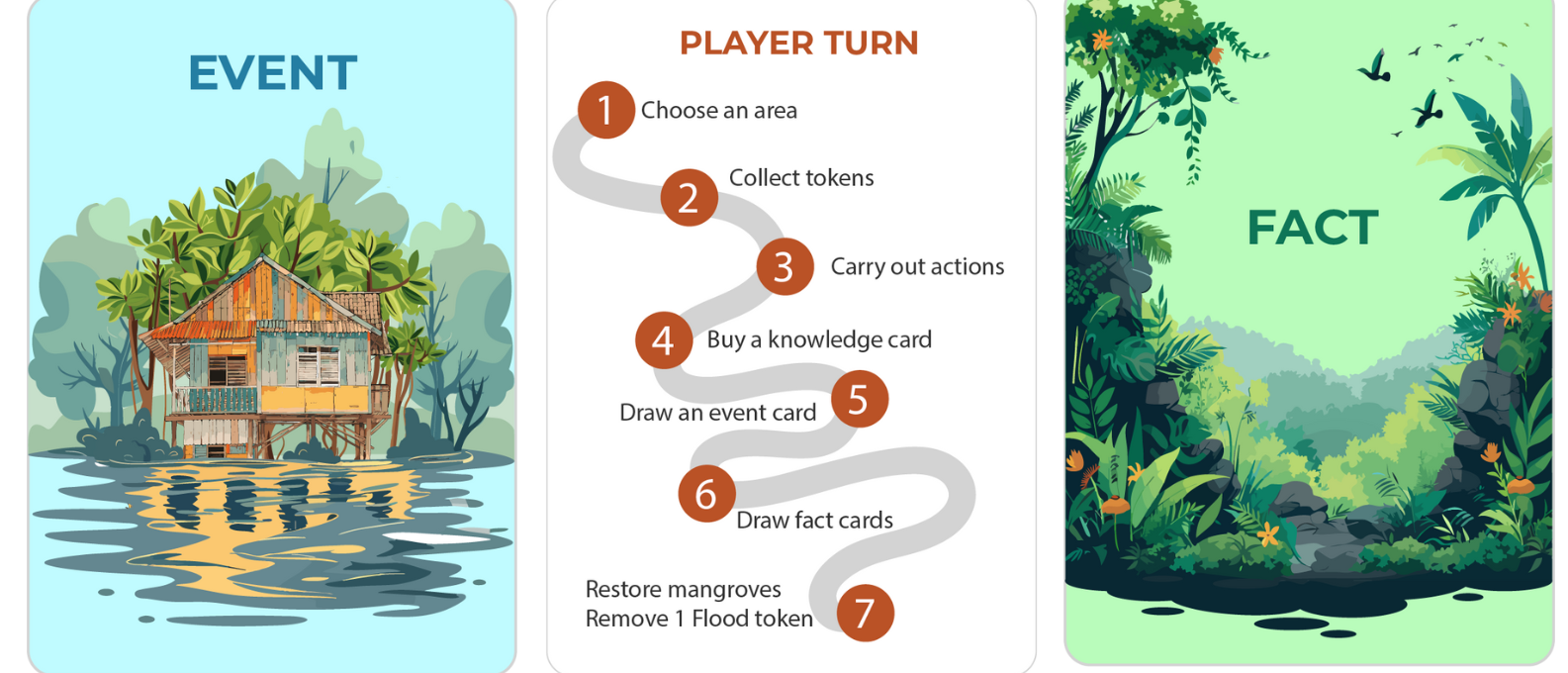
Six players work cooperatively to protect a mass of land from increasingly devastating flooding events. The land includes six zones, and within each zone are tiles that correspond to agriculture, businesses and industry, population centres, and natural features, including mangrove forests along the coast. The players assume specific roles, each with certain capabilities and skills that might prove useful. The goal is to work together, pooling resources and skillsets, to protect the land from flooding while growing the country’s economy, and population.
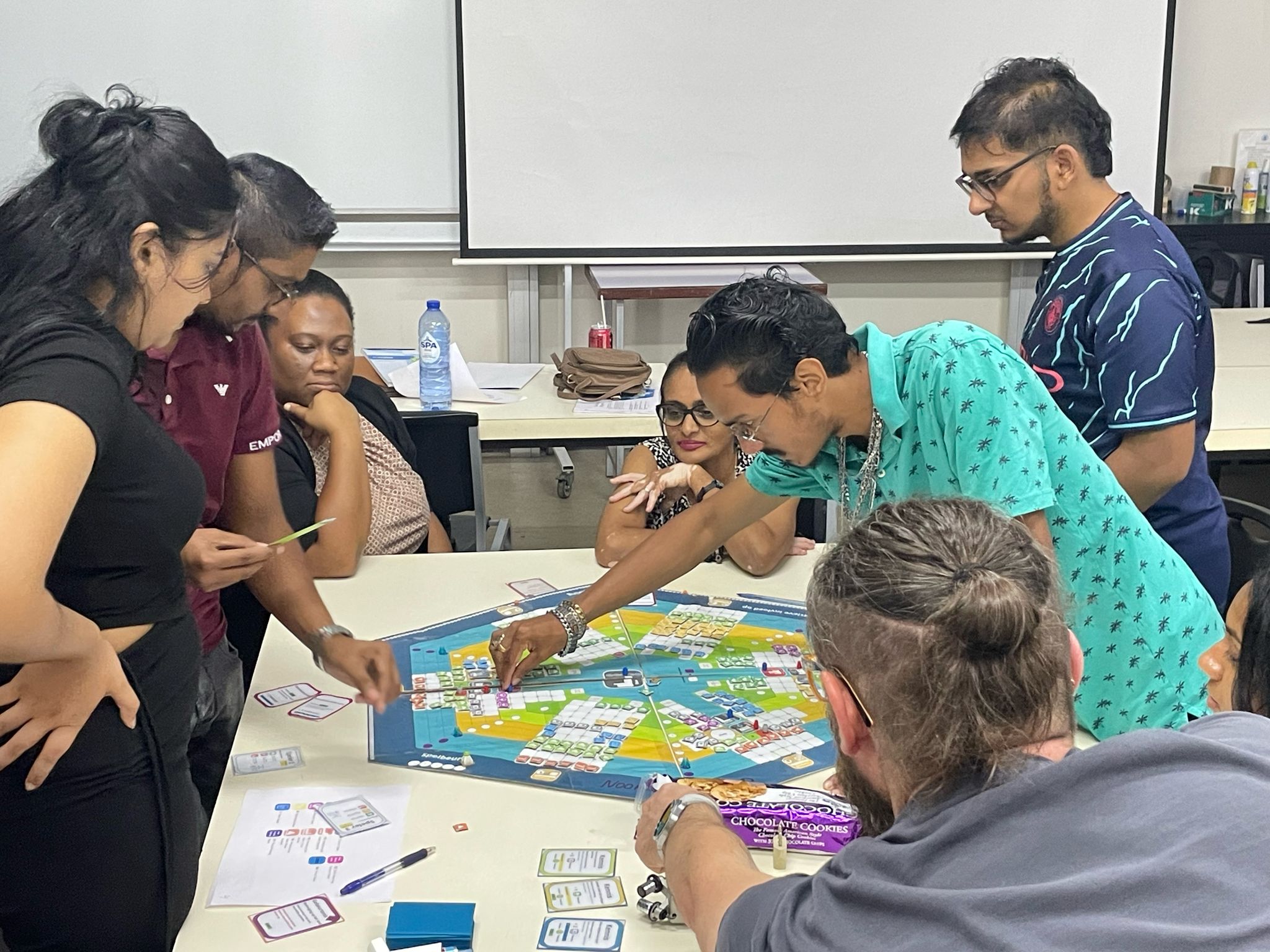
Since the first prototype, the game has seen many different forms. Each new version has been informed by the previous versions in an iterative and logical process. In March 2025, Sandy facilitated the initial gameplay testing with two groups of players from various locations along the Suriname coast and from varying backgrounds.
Meeting the communities involved and testing the game in situ has allowed me to observe player interaction and communications and better understand group dynamics.
Dr. Sandy Louchart, Research Associate in Game Design, University of Edinburgh
The playtests generated valuable insights that enabled further refinement of the gameplay. The final version of the boardgame is expected to be completed by early autumn 2025 and rolled out in Suriname in early 2026.
To find out more about ENHANCES, please visit www.enahncesproject.org, or contact the project Principle Investigator, Dr Isabella Bovolo, Durham University.
Blog kindly prepared by Dr Zane Havens, Outreach and Dissemination PDRA, Heriot Watt University, UK
This work has been generated by the ENHANCES (ENHANCing Coastal Ecosystem Services) research project, with funding from DEFRA -Global Centre on Biodiversity for Climate (GCBC), project GCBC RGC1 G01-007511, and shared contribution and responsibilities of Durham University (project lead), Edinburgh University and Heriot-Watt University in the UK and the Anton de Kom University in Surinam (local lead).