Project Summary
Countries: Madagascar
Delivery Partner: The Wildfowl and Wetlands Trust (WWT)
Project Partners: Madagasikara Voakajy (Mavoa)
Principal Investigator: Mark Grindley, Senior Project Manager (WWT)
Contact: mark.grindley@wwt.org.uk
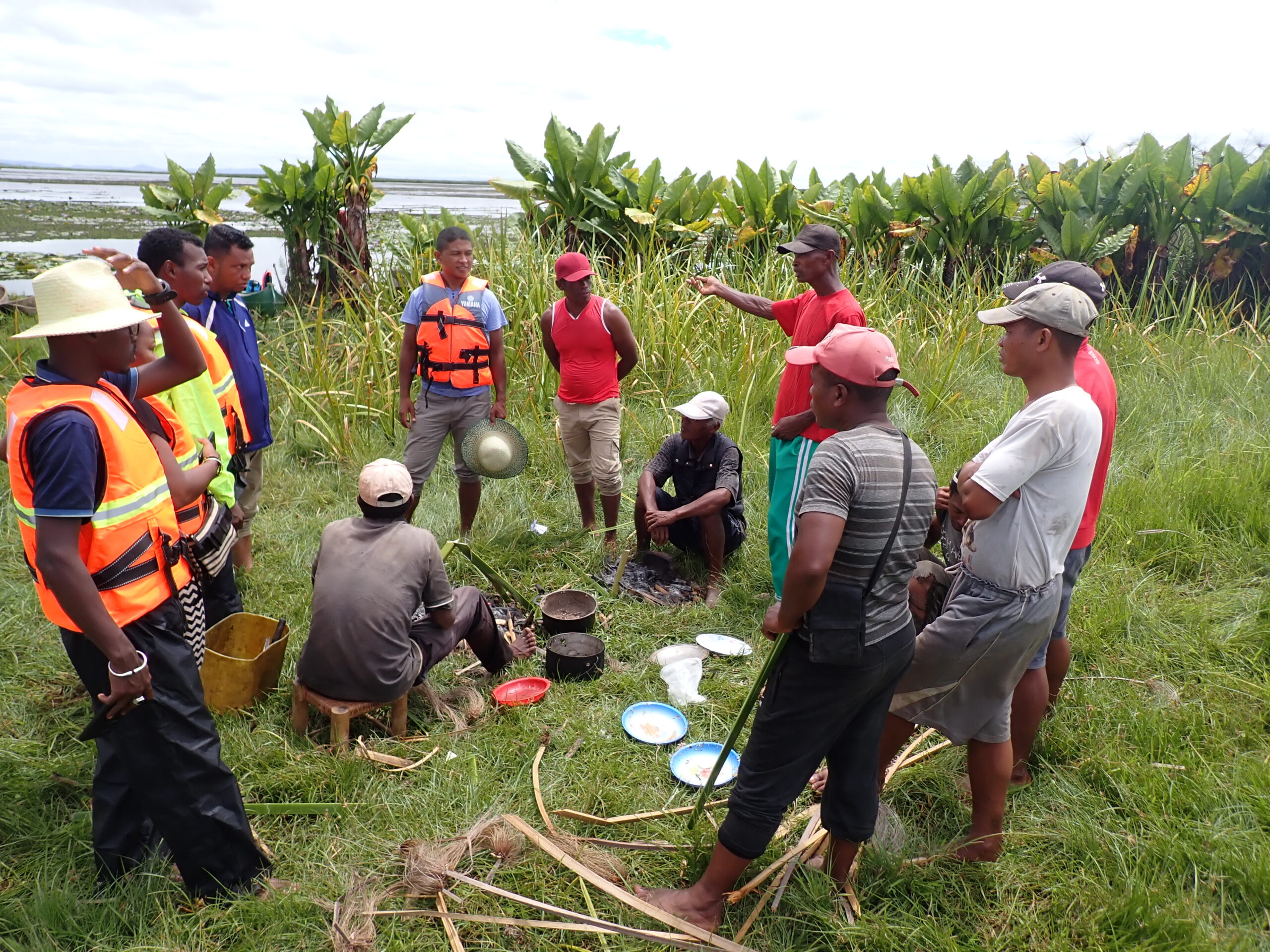

This project uses interdisciplinary, participatory research to understand the drivers of wetland degradation in Madagascar. It traces water through social, ecological, and biophysical elements of wetland catchments to build understanding and co-produce nature-based solutions with local communities.
Challenge
Madagascar is one of the world’s greatest biodiversity hotspots but is also one of the most threatened, with very high rates of habitat loss. This exists within one of the world’s poorest countries, with high rates of poverty, food insecurity and lack of access to clean water, and similarly high exposure to climate risks. Past conservation effort has largely targeted forests, but the country’s wetlands also support extraordinarily levels of endemism and numerous globally threatened species. They are also critical to the livelihoods of a large proportion of the mostly rural population.
Wetlands are however poorly represented in the protected area network and generally neglected in conservation initiatives. This means that links between poverty, environment, biodiversity and climate change are direct and immediate around Madagascar’s wetlands. By understanding those relationships we hope to leverage the power of nature to mutually strengthen them while addressing some of the drivers of degradation.
Insight
The project’s ambition supports the achievement of Madagascar’s wetland strategy by providing evidence and practical tools to bring positive impacts for biodiversity, poverty alleviation and improved ecosystem resilience across the nation’s globally and nationally important wetlands. It will achieve this ambition by providing evidence for the drivers of degradation to water quality and quantity in wetland social-ecological systems, and by testing solutions through participatory action-learning with our primary stakeholders and partners: wetland-dependent rural people.
This will lead to robust new evidence on the sustainable use of natural resources and the interconnectedness of biodiversity, climate and people, and help inform policy on the management of wetlands and their catchments, in line with the GCBC objectives. The project will also explore sustainable green financing options that have the potential to empower local communities and small holder farmers to implement nature-based solutions in the longer term.
Collaboration
Founded in 2005, Madagasikara Voakajy (Mavoa) is a Malagasy organisation dedicated to the conservation of endemic species and their habitats in Madagascar, for people and nature. Mavoa comprises a team of trained Malagasy researchers looking to use research results to inform and guide conservation actions. Due to the lack of suitable jobs in conservation they decided to work for themselves and their country, and since then they have gone from strength to strength, providing training opportunities to 73 young Malagasy field conservationists, implementing action plans on three threatened endemic spices, and benefiting at least 10,000 community members with training, livelihood support and employment.
Mavoa has been working at one of the project field sites – Lake Tseny – for several years and will enable its local partner community groups to fully participate in and benefit from the project.
Wetlands are amazing places with multiple super-powers, supporting wetland nature and livelihoods alike. With the right knowledge, tools and evidence, we believe Madagascar’s wetlands can be restored and managed more effectively by the people who depend on them the most – and in that way we hope to achieve the triple bottom line of economic, biodiversity and climate resilience impacts.
Mark Grindley
Mark Grindley is a conservation professional with over 25 years of experience designing and delivering interventions with multiple stakeholders, primarily in the Global South. He is particularly focused on empowering communities to manage natural resources for themselves and for nature. He works primarily to support the dedicated WWT Madagascar team to help shape their country’s future.